
Television is evolving, and one of the significant advancements is the way we consume content through internet protocol television. This technology allows users to access live broadcasts, stream video-on-demand, and watch time-shifted programming from any device connected to the internet.
Unlike traditional television broadcasting methods, internet protocol television offers flexibility and convenience. You can watch your favorite shows and movies on various devices, at any time, as long as you have a stable internet connection.
This shift in streaming technology is changing the way we enjoy content, making it more accessible and user-friendly.
Key Takeaways
- Internet Protocol TV delivers television content through internet protocols.
- It offers flexibility to watch content on various devices.
- Users can access live broadcasts, video-on-demand, and time-shifted programming.
- A stable internet connection is required to access the service.
- Internet Protocol TV is changing the traditional television landscape.
What Is IPTV? Defining Internet Protocol Television
The way we watch television is changing with the advent of IPTV, or Internet Protocol Television, which delivers content over the internet. IPTV is a service that allows users to stream their favorite TV shows and movies using a broadband connection, rather than traditional satellite or cable formats.
The Evolution from Traditional TV to IPTV
The evolution from traditional TV to IPTV began in the 1990s with advancements in technology such as motion-compensated DCT video compression and asymmetric digital subscriber line (ADSL) data transmission. These developments enabled television programming to be squeezed into limited bandwidth, paving the way for IPTV. Unlike traditional broadcasting, IPTV uses a client-server model, allowing viewers to request specific content that is then delivered individually to their device.
Key Terminology and Concepts
Understanding IPTV requires familiarity with key terminology. Multicast refers to the broadcasting of live TV to multiple users simultaneously, while unicast is used for on-demand content delivered to individual users. Middleware is the software that connects the user interface with the back-end service, enabling a seamless viewing experience.
| Term | Description |
|---|---|
| Multicast | Live TV broadcasting to multiple users |
| Unicast | On-demand content delivery to individual users |
| Middleware | Software connecting user interface to back-end services |
IPTV represents a convergence of telecommunications and television technologies, creating a more interactive and personalized viewing experience. As internet infrastructure continues to advance, IPTV is poised to become an even more integral part of our entertainment landscape.
How IPTV Works: The Technical Foundation
Understanding how IPTV works requires a dive into its technical backbone, which enables seamless content delivery. IPTV delivers television content over the internet rather than through traditional broadcast methods, relying on several key components to function effectively.
IPTV Architecture Explained
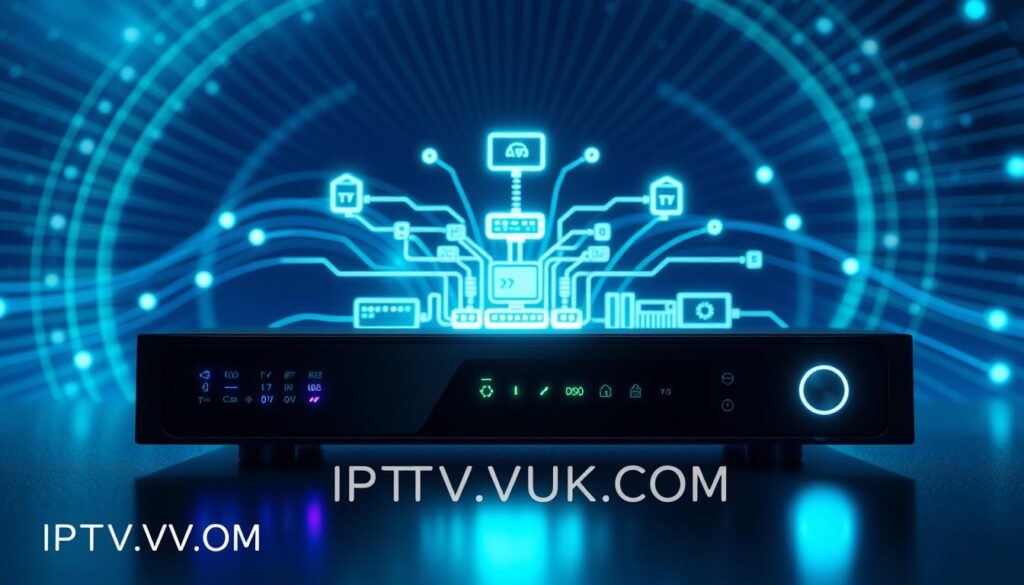
IPTV architecture is the framework that supports the delivery of television content over the internet. At its core, IPTV works by converting traditional television signals into data packets that can be transmitted over IP networks, essentially treating video content like any other data on the internet.
The process begins at the IPTV head-end, where live TV channels and audiovisual sources are encoded, encrypted, and delivered as IP multicast streams. Video-on-demand content is stored on servers and delivered as IP unicast streams when requested. IPTV architecture can be either centralized or distributed, with the choice depending on the service provider’s needs and infrastructure.
Protocols and Data Transmission
The technical foundation of IPTV relies on various protocols for efficient data transmission. Protocols like Real-time Transport Protocol (RTP) over User Datagram Protocol (UDP) are used for live streaming, while HTTP is used for video-on-demand content. IP multicast allows live data to be sent to multiple receivers using a single multicast group address, making it efficient for live broadcasts.
When a viewer selects a channel, the Internet Group Management Protocol (IGMP) handles the subscription to the multicast stream. Meanwhile, Protocol Independent Multicast (PIM) routes the content through the network, duplicating packets as needed to reach all viewers. Efficient data compression technologies reduce the bandwidth requirements, making it feasible to deliver high-quality video over standard internet connections.
The Core Components of an IPTV System
At the heart of every IPTV service are multiple core components that work together to bring television content to your device. These components are crucial for delivering a seamless viewing experience.
Content Sources and Encoding
The journey of IPTV content begins with its sources, which include live broadcast feeds, pre-recorded shows, and movies. These raw content sources are processed through encoding systems that compress the video and audio into digital formats like H.264/MPEG-4 AVC or H.265/HEVC. This compression reduces data bandwidth requirements while maintaining quality. Efficient encoding is essential for ensuring that the content is delivered smoothly.
Delivery Networks and Servers
The delivery network forms the backbone of the IPTV service, typically consisting of a robust fiber optic infrastructure. This ensures sufficient bandwidth for delivering multiple simultaneous streams without congestion or quality degradation. Specialized servers handle different aspects of the service: content servers store encoded media, streaming servers manage the delivery of content to users, and middleware servers handle user authentication, billing, and the electronic program guide (EPG).
End-User Equipment Requirements
On the user end, equipment requirements include a high-speed internet connection, a compatible device for viewing, and sometimes a dedicated set-top box that connects to the television. Modern set-top boxes not only decode the incoming IP streams but often provide additional features like time-shifting and recording capabilities. Many users now access IPTV services directly through smart TVs, computers, tablets, or smartphones using dedicated applications, eliminating the need for a separate device while maintaining the full functionality of the service.
| Component | Description | Key Features |
|---|---|---|
| Content Sources | Live broadcasts, pre-recorded shows, movies | Encoding for digital formats |
| Delivery Network | Fiber optic infrastructure | Sufficient bandwidth, quality assurance |
| End-User Equipment | High-speed internet, compatible devices, set-top box | Decoding, time-shifting, recording capabilities |
IPTV What: Different Types of IPTV Services
IPTV technology supports several types of services, each designed to meet specific consumer needs. These services offer a range of viewing experiences, from traditional live television to on-demand content.
Live Television Broadcasting
Live Television Broadcasting through IPTV mirrors traditional TV by streaming channels in real-time. It adds features like pausing, rewinding, and recording live broadcasts. Popular examples include Hulu + Live TV, YouTube TV, and Sling TV. This service type uses multicast streaming to deliver content to multiple viewers simultaneously.
Time-Shifted Media and Catch-Up TV
Time-Shifted Media and Catch-Up TV allow viewers to watch previously aired content for a limited period after the original broadcast. Platforms like BBC iPlayer and Hulu offer this functionality, providing flexibility in viewing schedules.
Video on Demand (VOD) Services
Video on Demand (VOD) represents the most flexible IPTV service type, enabling users to select and watch specific content at any time. Major providers include Netflix, Amazon Prime Video, and Disney+, offering vast catalogs of movies and TV shows. VOD services use unicast streaming to deliver content to individual users on request.
Near Video on Demand (NVOD)
Near Video on Demand (NVOD) serves as a middle ground between scheduled broadcasting and true on-demand viewing. It offers the same content at staggered start times throughout the day, similar to hotel movie systems.
| Service Type | Description | Examples |
|---|---|---|
| Live TV | Real-time streaming with pause/rewind features | Hulu + Live TV, YouTube TV |
| Time-Shifted/Catch-Up TV | Watch previously aired content within a limited time | BBC iPlayer, Hulu |
| VOD | Watch specific content at any time | Netflix, Amazon Prime Video |
| NVOD | Content available at staggered start times | Hotel movie systems |
These different IPTV service types can be offered individually or combined into comprehensive packages, providing viewers with maximum flexibility in how they consume content.
IPTV vs. Traditional Television: Key Differences
The rise of IPTV has sparked a comparison with traditional television, highlighting distinct approaches to content delivery. Traditional television, encompassing cable and satellite TV, has been the cornerstone of home entertainment for decades. However, IPTV is changing the landscape by offering a different method of content transmission and user interaction.
Transmission Methods Compared
Traditional TV uses a one-way broadcast signal, where content is transmitted continuously to all viewers. Cable TV transmits through coaxial cables, while satellite TV broadcasts from orbital satellites to a dish at the viewer’s location. In contrast, IPTV uses an Internet Protocol (IP) based network, delivering TV channels to users’ set-top boxes through a two-way communication system.
| Feature | Traditional TV | IPTV |
|---|---|---|
| Transmission Method | One-way broadcast | Two-way IP based |
| Content Delivery | Continuous stream | On-demand/requested content |
| Connection Type | Wired (cable) or wireless (satellite) | Internet connection |
User Experience and Flexibility
The differences in transmission methods significantly impact user experience. Traditional TV follows a rigid schedule, limiting viewers to the broadcast timeline. IPTV, on the other hand, offers on-demand viewing, allowing users to watch content at their convenience. Additionally, IPTV enables features like pausing live TV and accessing content across multiple devices, enhancing viewer flexibility.
IPTV also revolutionizes content discovery with sophisticated search functions, personalized recommendations, and content categorization. While traditional TV relies on channel surfing and program guides, IPTV platforms provide a more interactive and user-friendly experience.

Popular IPTV Service Providers
The world of IPTV is diverse, with various IPTV service providers catering to different needs and preferences. The IPTV market features numerous service providers ranging from major telecommunications companies to specialized streaming platforms, each offering different channel lineups, features, and pricing structures.
Legitimate IPTV Platforms
Legitimate IPTV platforms include well-established IPTV services like Hulu + Live TV, which combines live channels with on-demand content; YouTube TV, known for its unlimited DVR storage; and Sling TV, which offers more budget-friendly subscription options. Many traditional telecommunications providers have launched their own IPTV services, such as AT&T TV (now DirecTV Stream), Bell Fibe TV in Canada, and BT Vision in the UK, leveraging their existing infrastructure to deliver television content over IP networks.
Features to Look for in IPTV Services
When evaluating IPTV services, consumers should look for key features including content variety, streaming quality options (HD/4K support), multi-device compatibility, cloud DVR capabilities, and simultaneous stream allowances. The user interface and experience vary significantly between providers, with some offering intuitive navigation and powerful search capabilities while others focus on personalized recommendations and content discovery features. For more information on setting up IPTV, you can visit this guide.
Pricing models differ across providers, with options ranging from basic packages with limited channels to comprehensive offerings that include premium networks, with many services now offering flexible, contract-free subscription options. It’s crucial to distinguish between legitimate IPTV services that properly license their content and unauthorized providers that may operate in legal grey areas, as the latter can face service interruptions and legal challenges that affect the viewing experience.
Setting Up IPTV at Home: A Step-by-Step Guide
Setting up IPTV is an easy task when you have the right information and equipment. To enjoy IPTV, you’ll need a few essential components: a reliable internet connection, access to software or an app to manage your IPTV channels, and a device to display the content on your TV.
Internet Connection Requirements
A stable internet connection is crucial for streaming IPTV content. Most services recommend a minimum speed of 5-10 Mbps for standard definition, 15-25 Mbps for HD, and 25-50 Mbps for 4K streaming. For a smooth viewing experience, consider using a wired Ethernet connection instead of Wi-Fi, especially for high-definition content.
Choosing the Right Hardware
When it comes to hardware, you have two main options: a dedicated IPTV set-top box or using existing devices like smart TVs, streaming sticks, or mobile devices. Popular box options include Amazon Fire TV Cube, Apple TV, and Nvidia Shield. If you prefer using existing devices, ensure they are compatible with your IPTV service provider’s app.
Software and Apps for IPTV
Most legitimate IPTV providers offer dedicated apps for various platforms, including iOS, Android, Roku, and smart TV operating systems like Samsung’s Tizen and LG’s webOS. To set up IPTV, create an account with your chosen provider, download their app or configure your set-top box, and customize your viewing experience. For more detailed instructions, you can refer to guides like the IPTV tutorial or the essential guide to setting up your IPTV.
By following these steps, you can enjoy a seamless IPTV experience at home. Remember to check the limitations on simultaneous streams allowed by your provider if you’re planning to use multiple devices at once.
The Advantages of IPTV
IPTV services revolutionize television viewing with their modern and flexible approach. By offering on-demand content and flexibility, IPTV is changing the way we consume television. You can now watch your favorite shows anytime, anywhere, and on any device, making it a significant upgrade over traditional TV viewing.
Flexibility and On-Demand Content
One of the primary advantages of IPTV is its flexibility. Unlike traditional TV, which follows a rigid broadcast schedule, IPTV allows viewers to watch what they want, when they want. This on-demand nature gives access to vast libraries of content, including live events, movie libraries, and serialized shows. You can pause, rewind, and fast-forward through content without needing additional hardware or complicated setups.
Multi-Device Compatibility
IPTV services offer multi-device compatibility, allowing subscribers to switch seamlessly between watching on their TV, computer, tablet, or smartphone. Many IPTV services synchronize viewing progress across devices, enhancing the viewing experience. This flexibility means you can start watching a show on one device and continue on another without interruption.
Enhanced Interactive Features
IPTV services also provide enhanced interactive features that set them apart from traditional television. These include content recommendations based on viewing history, interactive program guides, and search functionality. Many IPTV platforms offer social integration features, allowing viewers to share what they’re watching and discuss shows with friends, creating a more connected experience. For more information on IPTV and its benefits, you can visit this guide.
Potential Drawbacks and Limitations
The IPTV experience is not without its drawbacks, primarily due to its reliance on internet connectivity. While it offers flexibility and on-demand content, several limitations can impact the overall viewing experience.
Internet Dependency Issues
A stable and fast internet connection is crucial for uninterrupted IPTV streaming. Poor connectivity can lead to buffering, interruptions, and low-resolution streaming. Unlike traditional cable television, which maintains consistent quality once installed, IPTV quality can fluctuate based on internet traffic conditions, time of day, and competing network usage within the home.
- Network issues like outages, congestion, or bandwidth throttling can cause service interruptions.
- IPTV quality can degrade during peak usage times due to internet traffic conditions.
Legal and Copyright Considerations
The legal landscape surrounding IPTV services can be complex. Some providers operate in regulatory grey areas by offering access to content without proper licensing agreements. It’s essential to choose reputable IPTV services to avoid potential legal issues.
| Issue | Description | Impact |
|---|---|---|
| Licensing Agreements | Some IPTV providers lack proper licensing | Potential service disruptions due to legal challenges |
| Content Availability | Regional licensing restrictions limit content | Inconsistent content library compared to traditional cable |
| Subscription Fatigue | Multiple IPTV subscriptions needed for comprehensive content | Increased cost for consumers |
In conclusion, while IPTV offers many benefits, understanding its limitations is crucial for a seamless viewing experience. By being aware of internet dependency issues and legal considerations, users can make informed decisions about their IPTV service choices.
The Future of IPTV Technology
The future of IPTV is bright, with emerging trends and innovations set to redefine the television landscape. The global Internet Protocol Television (IPTV) market size was estimated at USD 68.84 billion in 2023 and is projected to reach USD 200.22 billion by 2030, growing at a CAGR of 16.8% from 2024 to 2030.
Emerging Trends and Innovations
Several emerging trends are shaping the future of IPTV. The increasing adoption of artificial intelligence and machine learning is enhancing content recommendations and improving video compression efficiency. The rollout of 5G networks will provide faster, more reliable wireless connections, supporting higher quality streaming. Technological innovations in video compression, such as the adoption of AV1 and future codecs, will enable higher quality streaming at lower bitrates.
- Enhanced content personalization through AI-driven recommendations
- Improved streaming quality with 5G networks and advanced codecs
- Increased accessibility of 4K and 8K content
Integration with Other Smart Home Technologies
IPTV services are becoming increasingly integrated with other smart home technologies. Voice assistants like Amazon Alexa, Google Assistant, and Apple’s Siri are enabling hands-free control of television content. The boundary between traditional broadcasting and IPTV is blurring, with conventional television networks launching their own streaming platforms and IPTV services offering more live content.
For a seamless IPTV solution, consider providers that offer uninterrupted streaming and advanced features.
| Trend | Impact |
|---|---|
| AI and Machine Learning | Enhanced content recommendations and personalized viewing experiences |
| 5G Networks | Faster, more reliable wireless connections for higher quality streaming |
| Advanced Video Compression | Higher quality streaming at lower bitrates, making 4K and 8K content more accessible |
IPTV for Business Applications
IPTV technology extends far beyond residential entertainment, offering powerful solutions for businesses across various sectors that need to distribute video content efficiently throughout their facilities. This capability makes IPTV an invaluable tool for enhancing customer experience, improving internal communications, and providing entertainment or information to employees and clients alike.
Commercial Uses in Hospitality and Corporate Settings
In the hospitality industry, IPTV systems have revolutionized in-room entertainment by allowing hotels to offer personalized welcome messages, targeted information about hotel amenities, video check-out services, and premium content without the need for traditional cable infrastructure in each room. Corporate environments utilize IPTV for internal communications, broadcasting company announcements, training videos, and live events to multiple locations simultaneously. The scalability of IPTV makes it particularly valuable for large venues like airports, stadiums, and convention centers, where content can be delivered to hundreds or thousands of displays. For those interested in launching an IPTV service, exploring options with a reputable IPTV service provider can be a strategic move.
IPTV in Education and Healthcare
In educational settings, IPTV enables schools and universities to distribute lecture recordings, educational programming, and campus announcements, creating a connected campus experience. Healthcare facilities implement IPTV systems to provide entertainment for patients, deliver educational content about medical procedures, and share important facility information, contributing to improved patient satisfaction. The business applications of IPTV benefit from specialized features such as content scheduling, emergency broadcast capabilities, and integration with facility management systems, making it a versatile solution for various business needs.
Conclusion: Is IPTV Right for You?
The decision to adopt IPTV depends on various factors, including your viewing habits and technical setup. IPTV services offer a new way of watching TV, delivering content over the internet and eliminating the need for physical decoders or antennas.
To determine if IPTV is right for you, consider your internet connection quality, as it plays a crucial role in the viewing experience. Those with fast, reliable broadband will enjoy seamless streaming, while viewers with slower connections may experience interruptions.
It’s also essential to research the content availability on different IPTV services and compare their channel lineups and on-demand libraries. For many viewers, a hybrid approach combining select IPTV services with traditional methods may be the ideal solution. You can explore more about IPTV subscriptions to make an informed decision.
Ultimately, IPTV offers flexibility and a personalized viewing experience, making it an attractive option for those seeking more control over their television consumption.